From pilot radio call to active flight record.

ADX-1 turns a normal dispatch radio call into live aircraft state, overdue monitoring, SMS escalation, and a searchable record.

How It Works

1

Pilot calls dispatch

on the Aviation Utility Service frequency

2

ADX-1 responds and opens the flight record

flight following activated

3

Aircraft tracked

distributed situational awareness via displays

4

Pilot cancels flight following

back on the ground, mission complete

5

Flight closed and logged

record preserved

6

Late? ADX-1 alerts

via SMS tiered list, current position

Workflow sequence

Call → Confirm → Track → Close → Report

1

The pilot opens flight following by radio.

The pilot uses a structured dispatch call on your aviation dispatch frequency. Example: "Dispatch, Helicopter Three Eight Five Two Quebec, VFR to LAX, one point five hours." ADX-1 hears the radio transmission. The system is listening for a bounded operational request looking for: Dispatch identifier, Aircraft identifier, Flight type, Expected duration, Open/close/cancel intent. The pilot uses the dispatch frequency. ADX-1 becomes the automated listener on the other end.
2

ADX-1 recognizes the intent.

After the pilot transmits, ADX-1 recognizes the intent and opens a flight record, turning a radio call into an aircraft state. Recognizing intent
3

ADX-1 prompts for missing information.

Radio calls get clipped. Flight type or duration may be omitted. ADX-1 is designed for that. If the system cannot confidently open the flight record, it will prompt the pilot for the missing field. Examples: • "Aircraft calling dispatch, say again." • "Helicopter Three Eight Five Two Quebec, say flight type." • "Helicopter Three Eight Five Two Quebec, say duration." Missing information prompt
4

ADX-1 replies over the radio.

When the call is complete and valid, ADX-1 generates a response from an approved phraseology template. The system uses text-to-speech and push-to-talk control to transmit back over the dispatch radio. Example: "Helicopter Two Four Four Romeo Hotel, flight following active, production flight test, ninety minutes." The pilot hears exactly what ADX-1 understood.
5

The pilot can correct the system immediately.

Speech recognition is not perfect, and aviation radio is not a studio microphone. ADX-1 is designed for the real world. If the pilot hears an incorrect readback, they can immediately correct or cancel the event using clear language such as "Negative" or "Cancel."
6

The flight becomes active on the operations display.

Once confirmed, the flight-following record becomes active. The operations display shows the flight state and other relevant information to the people responsible for distributed situational awareness. Operations display
7

ADS-B supports the dispatch record.

ADX-1 correlates available ADS-B data from radio and internet sources with the active flight. The system shows position, altitude, groundspeed, track, last update time, and last-known location. The dispatch state starts with the pilot's intent, opening the watch and aggregating information into one situational awareness picture.
8

ADX-1 watches the expected return time.

When the flight-following record opens, ADX-1 starts the dispatch timer based on the duration confirmed with the pilot. During normal operations, the system stays quiet. It watches the flight state in the background. If the flight remains active past the expected time, it begins to escalate. Dispatch timer
9

The pilot closes flight following by radio.

At the end of the operation, the pilot calls dispatch to cancel or close flight following. ADX-1 closes the active record, updates the display, and confirms by radio. The flight is no longer active however the record is immutably preserved. Close flight following
10

Late and overdue flights escalate by SMS.

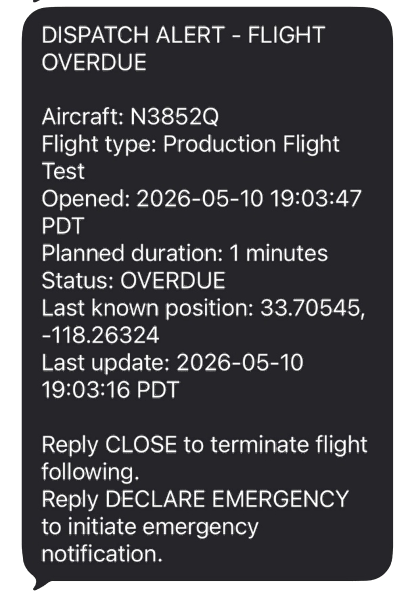
When a flight state requires human attention, ADX-1 alerts responders in tiered groups via SMS, email, and on distributed displays. Responders can act from SMS. They can close a flight if the state is known and safe. They can escalate if the aircraft status is confirmed abnormal or declare an emergency relevant condition according to company procedures or the ERP. ADX-1 moves the right information to the right people at the right time. SMS escalation
11

Humans make the operational decision.

ADX-1 supplements, but does not replace your Emergency Response Plan. The system maintains the watch, logs everything, distributes information, and escalates. Humans remain responsible for the response. Human decision
12

The operation keeps a searchable record.

ADX-1 logs everything. Radio broadcasts, clearances, structured readback, Aircraft identifier, Flight type, Expected duration, Open time, Close time, Flight duration, Late or overdue state, SMS alerts, Responder actions, Manual extensions, Manual closeouts, Last-known ADS-B data, System health state, and all in an immutable record. That gives the operation a record of what happened, when it happened, and how the loop was closed. Routine radio calls become useful operational data. Rich reporting data drives decisions.

Automate your dispatch

ADX-1 gives small aviation fleets a radio-native way to automate routine flight following. Adding a layer of safety, without adding headcount.

Request Demo


Safety First, Automation Second